What is last-mile connectivity?

Last-mile connectivity is the final link between a business location and the provider network that connects employees, devices, and applications to the cloud. It affects how reliably people, applications, devices, and business systems connect to cloud platforms and to each other.
For businesses using cloud services, that final link shapes speed, uptime, customer experience, and day-to-day productivity. As more work moves to distributed sites, the last mile plays a larger role in performance planning, cloud resilience, and business continuity.
Key points:
- Last mile networks provide the final connection to end users, connecting through middle mile networks that aggregate local traffic and carry it to the broader internet backbone.
- Local access limits, shared capacity, construction issues, and outages often create the slowdowns users notice first.
- Effective planning matches each site’s access options to performance, cost, uptime, recovery, cloud resilience, and growth needs.
- Resilient last-mile design supports cloud, edge, connected device, and artificial intelligence (AI) strategies across distributed locations.
The cloud may be ready. The application may be well built. The network core may be strong. A slow, crowded, or unstable local access connection still affects the user experience first.
Last-mile connectivity shapes how cloud apps, collaboration tools, payment systems, connected devices, security platforms, and AI workloads perform.
The role of the last mile in cloud performance
Cloud performance depends on the full path between users and applications. The last mile is the part of that path closest to the business location. It’s also one of the most variable.
Your company may use cloud apps, private connections, and modern security tools. But each site still needs enough local capacity. Performance can change based on the options available nearby.
Private connectivity creates a more controlled path between a business network and cloud services. It doesn’t replace the need for resilient local access. The last mile still carries traffic from the business location to the provider network.
An overloaded or poorly backed-up link affects cloud-dependent work, even with a well-designed network core, making last-mile design a key part of cloud resilience.
How last-mile connectivity works
The last mile is only one part of the path data takes to reach a business site. Before traffic arrives at a local connection, it typically moves through long-haul and regional networks that carry data across large distances. This journey is often described in three main stages.
Data delivery happens in three main stages.
- The backbone carries traffic over massive, high-capacity fiber networks that span continents and oceans.
- The middle mile moves data through regional networks between cities, markets, and major hubs.
- The last mile is the final segment that connects a business location to the provider network and, from there, to the internet, cloud platforms, and digital services.
That final segment may run over fiber, dedicated internet, fixed wireless, 5G, cable, copper, or satellite service, depending on what is available at each site. Hybrid designs may combine several access types to improve capacity or resilience.
The “last mile” is often where performance bottlenecks appear. Speed and reliability can depend on local conditions, provider access, and the building itself.
The impact is direct. A weak last-mile link can slow daily operations and make key systems less reliable. It may be the local access path, but it also connects the site to the larger enterprise network. That connection point is where last-mile performance begins to shape the network edge.
Last-mile connectivity and the network edge
The network edge places processing closer to the people, devices, and applications that need it. It can include equipment at or near a business site, as well as nearby data centers and wireless access points.
The last mile connects business sites and devices to the edge. A nearby edge location can reduce delay, but it won’t fix a weak local access link. Data still has to move between the site, the edge, and the cloud.
For example, a security system may process video near a business location instead of sending every feed to a distant data center. That can improve response time, but the last-mile connection still carries data to and from the site. If that connection is slow or unstable, reliability suffers.
As businesses use more digital tools and cloud services, the last mile and the edge work together to shape speed, uptime, and resilience.
AI workloads and last-mile connectivity
AI workloads are increasing pressure on last-mile networks. Some AI data is processed near a business site to reduce delay. Other data moves over the last mile for storage, analysis, or action in cloud platforms. That creates more demand for low latency, strong upload capacity, and reliable two-way traffic.
Distributed AI workloads need low-latency paths to inference endpoints near data sources. Local access is now part of AI performance, not a minor network detail. Download speed still matters, but many AI tools, cameras, sensors, and analytics platforms send large amounts of data upstream. Without enough upload capacity, AI performance can suffer.
Network teams also use AI to monitor congestion, latency, and link health, but results still depend on connections built for the workload.
Selecting and improving last-mile connectivity
Different sites may prioritize different needs, from high-capacity office connectivity to backup access for stores, wireless coverage for warehouses, or fast deployment for temporary locations.
Start by reviewing current and future bandwidth needs, including upstream traffic. Identify applications that require low latency, steady performance, or high availability. Then match access choices to the business risk of a slowdown or outage.
Planning should include:
- Provider availability and installation timelines.
- Upload and download capacity needs.
- Service-level agreements for uptime, repair, and support.
- Backup paths, such as business fiber plus wireless.
- Cloud resilience goals for failover, recovery, and application availability.
- Real-time traffic needs, including voice, video, payments, and security systems.
- Private cloud connectivity requirements.
Common upgrades include replacing copper with fiber, adding a second circuit, using link aggregation, and using SD-WAN to manage several links. For cloud-intensive sites, private cloud connections can reduce exposure to public internet congestion and make performance more predictable.
Last-mile options at a glance
Last-mile access options vary by site, availability, performance needs, and deployment timelines. The table below compares common access types and where each one may fit in a broader connectivity plan.
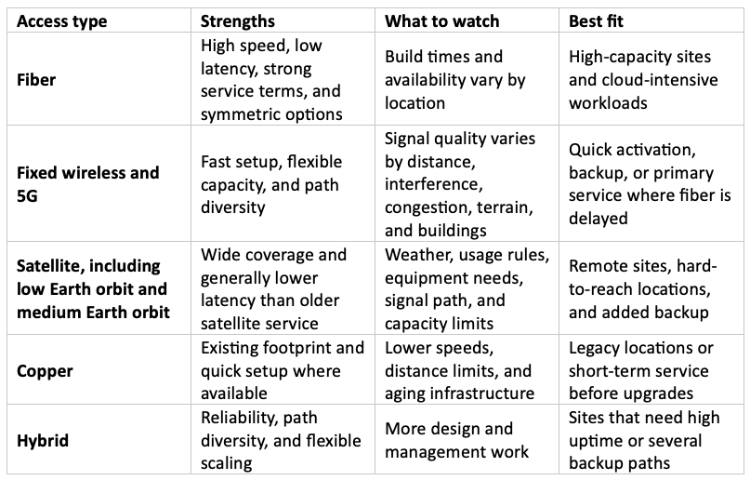
The best access type depends on location, workload, budget, risk, and recovery needs. Many businesses use more than one option to reduce the risk of a single local outage.
That same choice also affects resilience. The last-mile design determines how traffic keeps moving when a local link slows, fails, or becomes congested.
Cloud resilience starts with last-mile design
Cloud resilience depends on more than cloud architecture. It also depends on the local access paths that keep sites connected to cloud platforms during normal operations, congestion, and outages.
A resilient cloud architecture still falls short with a slow, unstable, or overloaded local access link. Organizations that rely on cloud platforms across many sites need local access plans that support daily operations and recovery goals.
Private cloud connectivity creates more predictable paths between business networks and cloud providers. High-capacity site access supports locations that need reliable connectivity for cloud-intensive work.
Together, resilient site access and private cloud connectivity improve application performance, support growth, and reduce the risk that local access problems disrupt cloud-dependent work.
Last-mile connectivity FAQs
Last-mile connectivity is a common source of performance and reliability questions because it depends on local infrastructure, site conditions, and available access technologies. Common FAQs include the following:
The last-mile problem
The last-mile problem is the challenge of making the final network connection fast, reliable, and affordable. Local infrastructure, distance, construction access, terrain, and provider availability often make upgrades harder.
Technologies used for last-mile internet
Common options include fiber, cable, fixed wireless, 5G, satellite, copper, and hybrid designs. The best choice depends on location, performance needs, uptime requirements, timing, and cost.
The last mile and internet speed
The last mile limits the speed users experience, even with a broader network. Aging lines, shared capacity, congestion, distance, signal quality, and outages all affect performance.
Challenges for last-mile networks
Common challenges include legacy infrastructure, construction delays, terrain, building access, provider availability, and repair timing. Businesses may also need stronger upload speeds, lower latency, and more reliable uptime.
Last-mile connectivity versus last-mile delivery
Last-mile connectivity is the final network link to a business location or device. Last-mile delivery is the final step of moving goods to a customer.
Effective last-mile planning helps keep cloud-connected sites performing reliably. It becomes part of the broader strategy for performance, uptime, recovery, and cloud resilience.
Building a resilient path from site to cloud
The impact of last mile connectivity extends beyond access alone. It shapes how well cloud apps respond, how reliably systems stay connected, and how quickly a business recovers from a local connection failure.
Effective planning matches each site to an access strategy that fits the business need. Download speed matters, but the right connection also needs to support reliable performance, recovery, and cloud access.
For businesses using cloud platforms, the last mile works best as part of a broader private connectivity and cloud resilience plan. Designed together, site access and private cloud connectivity support more consistent digital performance from the local site to the cloud.
Explore site-to-cloud connectivity options
As last-mile connectivity becomes more tied to cloud performance, your business needs access options that fit its sites, workloads, and growth plans. AT&T Business Fiber® can support high-capacity locations with fast, reliable connectivity.1
For workloads that need a more direct path to cloud providers, AT&T NetBond® can help improve connection predictability. You can also explore broader cloud connectivity options to see how access and cloud strategy work together. To connect with an expert who knows business, contact your AT&T Business representative.
Why AT&T Business
See how ultra-fast, reliable fiber, protected by built-in security, and 5G connectivity give you a new level of confidence in the possibilities of your network. Let our experts work with you to solve your challenges and accelerate outcomes. Your business deserves the AT&T Business difference—a new standard for networking.
1Limited availability in select areas.

Contact AT&T Business
Have questions? Call us at 888.255.4844 for more information about our business solutions.