Teleoperation: How it works, AI networking, and use cases
Teleoperation is an emerging operating model for enterprises that need skilled people to control machines in hazardous, remote, or understaffed locations. As robotics, 5G, private cellular networks, and edge computing converge, network performance increasingly influences whether remote operations remain responsive, secure, and resilient.
Artificial intelligence (AI)-assisted networking can help monitor command traffic, manage video and sensor data, anticipate congestion, and coordinate edge resources. Together, these capabilities can reduce operational risk, extend workforce reach, and scale automation without removing human judgment from decisions.
- Human operators can control machines in hazardous or distant locations without entering the work zone.
- AI-assisted networking can prioritize commands while adapting capacity for video, telemetry, and sensor traffic.
- Shared autonomy assigns routine movements to software while keeping operators available for complex decisions.
- Latency, jitter, security, local safeguards, and recovery procedures are key factors in the reliability of remote operations.
Together, these capabilities can create an integrated enterprise operating model built around people, machines, networks, and safeguards. To assess where teleoperation can create value, organizations first need a clear understanding of what teleoperation is and how it differs from related approaches.
What is teleoperation?
Teleoperation, or “teleop,” describes a remote operating model that involves human direction or supervision of a robot, vehicle, or other machine, although the level and timing of involvement vary. An operator issues commands through a console, and the machine returns video, audio, telemetry, or force feedback.
In direct control, an operator continuously controls the machine. In supervisory control, the operator sets goals or approves actions while onboard software manages routine execution.
Teleoperation differs from telepresence. Telepresence primarily emphasizes remote perception and presence, while teleoperation emphasizes controlling a machine or tool. Teleoperation adds the ability to act through wheels, steering systems, robotic arms, grippers, or tools.
It also differs from full autonomy. An autonomous system senses its environment, plans an action, and executes it without continuous human direction. Many enterprise systems combine these approaches: Software handles routine navigation, stabilization, or obstacle avoidance while an operator manages exceptions.
Teleoperation extends human judgment to machines beyond a worker’s physical reach. Its enterprise value becomes clearer when organizations examine the work it can support.
Enterprise teleoperation use cases
Teleoperation is often suited to work that’s hazardous, remote, difficult to staff, or too unpredictable for full autonomy. It can reduce worker exposure, connect specialists with multiple locations, and limit travel to distant sites.
Common enterprise applications include:
- Manufacturing recovery when equipment stops or encounters an exception
- Robot-assisted medical procedures in healthcare
- Warehouse operations and logistics
- Mining operations
- Utility inspection
- Disaster reconnaissance
- Explosive ordnance disposal (EOD) in public safety operations
The business case depends on the application. Relevant outcomes can include reduced worker exposure, faster specialist access, less travel, higher equipment utilization, shorter recovery times, and broader operational coverage.
Organizations should compare those benefits with the costs of equipment, integration, connectivity, training, cybersecurity, and support. Once a use case has a measurable objective, decision-makers can evaluate how the system must work to achieve it.
How teleoperation works
A teleoperation system connects the operator interface, control software, communications network, sensors, actuators, and local safety controls. Each component affects the control loop and must operate within defined performance limits.
Operator interface and situational awareness
The operator interface converts human intent into commands. A basic station may use a monitor and joystick, while advanced systems may include steering wheels, pedals, headsets, panoramic displays, or haptic controllers.
Operators need a clear view of the machine, its surroundings, and its operating state. Camera placement, image quality, depth cues, alerts, and control layouts affect how quickly and accurately they can respond. Interfaces should present urgent information without forcing operators to search crowded screens.
Control systems
Control software translates operator input into machine movement. Direct control translates operator input into movement of a wheel, arm, gripper, or tool.
Shared control adds software assistance for stabilization, braking, collision avoidance, route following, or speed control. With supervisory control, the operator sets a destination or goal, and onboard systems manage execution until an exception requires intervention.
Communications and network performance
The network carries commands to the machine and returns video, telemetry, sensor data, and other feedback. Four measures are particularly important:
- Latency: The time required to transmit and process data
- Jitter: Variation in latency over time
- Bandwidth: Capacity available for video, telemetry, and sensor feeds
- Packet loss: The percentage of packets that do not reach their destination
Control traffic requires dependable, timely delivery. Video and high-volume sensor feeds require sustained capacity, particularly on the uplink from the machine. Quality-of-service policies can prioritize command and safety traffic over less time-sensitive data.
Sensors, actuators, and safeguards
Cameras provide the primary view in many systems, but light detection and ranging (LiDAR), radar, and other sensors can add information about depth, distance, movement, pressure, temperature, and equipment condition. Haptic feedback can help operators judge contact or resistance.
Actuators, including motors, servos, hydraulic systems, wheels, and grippers, perform the physical work. Based on the risk assessment, local controllers should enforce applicable safety constraints, such as speed limits, geofenced boundaries, collision avoidance, or emergency stops.
Reliable teleoperation depends on interfaces, controls, networks, sensors, and safeguards operating as one system. That integrated design helps determine how organizations should divide responsibility between people and automation.
The differences between teleoperation and autonomous operation
Teleoperation places real-time control and judgment with a human operator. Full autonomy assigns sensing, planning, and execution to software. Shared autonomy divides those responsibilities according to the task.
People can interpret unfamiliar objects, unclear hazards, and changing priorities. Autonomous systems can repeat defined tasks without continuous attention. On the other hand, shared autonomy uses software for routine work while an operator handles exceptions.
For example, a warehouse robot may navigate independently until a blocked aisle requires human judgment. An inspection drone may follow a planned route but return control to an operator when it approaches damaged equipment.
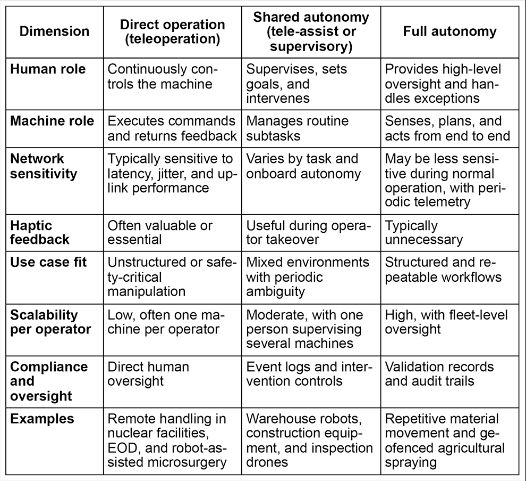
Operator scalability depends on task complexity, intervention frequency, workload, and regulatory requirements. All three modes may require access controls, event logs, safety validation, intervention procedures, and audit records.
The appropriate model depends on risk, operating conditions, network performance, and the need for human judgment. Once organizations approve that model, they can define how AI-assisted networking should support it.
The role of AI networking in teleoperation
Teleoperation may rely on both networking for AI and AI for networking. Networking for AI refers to infrastructure that carries AI workloads. AI for networking uses AI to monitor, optimize, and automate network operations.
AI-assisted networking can help detect congestion, allocate resources, coordinate edge computing, and identify conditions that could disrupt operations. It can’t eliminate delays caused by distance, radio conditions, application processing, or equipment limitations.
Controlling latency and jitter
Latency delays commands and feedback, while jitter makes those delays inconsistent. Operators may compensate for a short, steady delay, but fluctuating response times can reduce precision and cause overcorrection.
Engineering teams should measure jitter and high-percentile latency in addition to averages. Analytics can identify congestion or service degradation, while automated controls may reroute traffic, reallocate capacity, or adjust application behavior.
Allocating resources through network slicing
5G network slicing uses capabilities in the 5G Standalone (SA) architecture to create logical network segments with defined service characteristics. Network teams can configure a slice to support time-sensitive teleoperation traffic, subject to coverage, congestion, network design, and resource availability.
Performance still depends on the complete path through the radio access, transport, core, edge, application, and machine-controller environments. Network slicing alone doesn’t guarantee application performance.
Optimizing uplink traffic
Remote machines often send multiple video and sensor streams while receiving smaller command messages, making reliable uplink capacity important.
Video software can adjust resolution, frame rate, and compression as needs change. It might prioritize a navigation camera while a machine is moving, then shift capacity to a tool camera during an inspection. Limiting noncritical traffic can preserve capacity for commands and essential feedback.
Predicting degradation and coordinating edge resources
Network telemetry can reveal rising packet loss, weak coverage, increasing latency, or overloaded resources. Predictive models can alert operations teams before performance falls below an established threshold.
The system might then reduce noncritical video, preserve command traffic, alert the operator, and direct local controls to limit movement. If performance crosses a defined threshold, local controllers should place the machine in a validated safe state.
Edge computing places processing near the operating site, where shorter data paths can reduce response time. AI-assisted orchestration can direct workloads to available edge resources based on capacity and application requirements.
AI-assisted networking can improve resource allocation, monitoring, and recovery, but it doesn’t replace end-to-end design. Organizations must turn these capabilities into measurable enterprise requirements.
Designing teleoperation for enterprise use
Enterprise teleoperation requires a plan for performance, resilience, security, operator readiness, and governance. Systems must maintain safe, consistent operation during realistic workloads, network changes, equipment failures, and cyber incidents.
1. Define the business objective
Start with a measurable operational outcome, such as reducing worker exposure, avoiding travel, increasing equipment utilization, or shortening response times.
Relevant success measures include task completion, intervention frequency, downtime avoided, cost per task, safety-event rates, and recovery time. These metrics help determine whether a pilot should move into production.
2. Set an end-to-end latency budget
Allocate acceptable delay across the machine controller, video encoder, network, application, operator console, and return path. Requirements should reflect the task because video inspection, vehicle operation, precision manipulation, and fleet supervision have different performance needs.
Test normal and peak loads, network handoffs, weak coverage, component failures, and outage recovery. Track jitter and high-percentile latency because averages can conceal disruptive spikes.
3. Build end-to-end resilience
End-to-end network resilience requires more than a backup connection. Establish rules for switching access paths, preserving sessions, recovering data, and placing equipment in a safe state.
The design should address failures involving access networks, transport, edge infrastructure, applications, consoles, controllers, security services, and power. Teams must test failover regularly to confirm that it meets recovery objectives.
4. Apply security controls
Protect every operator, device, application, interface, and data path. Controls should include unique identities, multifactor authentication (MFA), role-based access, encryption, network segmentation, signed software, patch management, configuration controls, monitoring, and incident response.
The Cybersecurity and Infrastructure Security Agency advises manufacturers to eliminate avoidable weaknesses such as default passwords and unsupported components.1 Regulated industries may face additional requirements. Connected medical systems, for example, may need to address federal expectations for cybersecurity planning across the device life cycle.2
Organizations should limit sensitive data collection, define retention periods, and restrict access to recorded sessions.
5. Prepare operators
Training should cover normal operation, degraded connectivity, equipment failures, emergency stops, and transitions between automated and manual control. Simulators and digital twins can help teams rehearse these conditions without creating live hazards.
Organizations should also define operator qualifications, recertification, shift limits, handoff procedures, escalation paths, and operator-to-machine limits.
6. Define service-level objectives
Set measurable objectives for latency, jitter, packet loss, capacity, availability, recovery time, video quality, and security response. These objectives should establish when the system may continue operating, restrict functionality, or enter a safe state.
7. Establish governance and test a pilot
Assign ownership for system safety, network performance, device security, operator qualification, software changes, data governance, incident response, compliance, and vendor management.
Begin with a bounded use case. Test normal and degraded conditions, measure operator workload, validate failover and safe-state behavior, and compare results with the business case. Expand only after the deployment meets documented thresholds.
Enterprise teleoperation is ready to scale when performance, safety, security, workforce readiness, governance, and business outcomes meet defined requirements. These criteria also frame the questions decision-makers commonly ask before deployment.
Teleoperation FAQs
Why is latency critical in teleoperation?
Latency delays the machine’s response to your commands. Excessive or inconsistent delay can cause unstable movement, overcorrection, and missed hazards. Local safety controls help, but they can’t replace timely operator feedback.
How is teleoperation used with AI and robotics?
AI can handle object detection, stabilization, navigation, and anomaly detection, letting you focus on decisions that require human judgment. Authorized teams can use recorded sessions for robot training after reviewing the data for safety, privacy, quality, and relevance.
What are common teleoperation setups?
Systems may connect robots to nearby control rooms, regional edge sites, or remote operations centers. Operator stations range from desktop consoles to immersive systems with haptic controls. Your task, environment, and risk level determine the right setup.
How does teleoperation manage security and privacy?
Identity controls, encryption, network segmentation, and monitoring help protect machines and data. Your organization should also limit sensitive data collection, restrict access, define data-retention periods, and use local processing or redaction when practical.
Which operations are suitable for teleoperation?
Teleoperation suits hazardous or distant work, sites with limited expertise, and situations autonomous systems can’t resolve. Before deploying it, you should assess task complexity, network coverage, local safety controls, and operator workload.
Teleoperation allows skilled workers to operate equipment in dangerous, remote, or understaffed locations. Depending on the task, operators may control machines directly, supervise several machines, or rely on automation for routine work.
Intelligent networks can prioritize commands, manage data traffic, and detect service issues. However, they can’t replace safety controls, trained operators, or recovery plans. Success depends on the machine, operator, network, and safety systems working together. With clear limits and measurable performance, teleoperation can reduce risk and support greater automation.
The AT&T network uses AI and machine learning throughout the network design, planning, and build cycle to forecast traffic, plan capacity, and validate new network equipment. These capabilities help enhance customer experiences, including teleoperation and AI workloads.3
Explore AT&T Managed Services for expertise supporting business-critical network services, and AT&T cybersecurity services to help protect your connected operations.
To connect with an expert who knows business, contact your AT&T business representative.
Why AT&T Business
See how ultra-fast, reliable fiber, protected by built-in security, and 5G connectivity give you a new level of confidence in the possibilities of your network. Let our experts work with you to solve your challenges and accelerate outcomes. Your business deserves the AT&T Business difference—a new standard for networking.
1Cybersecurity and Infrastructure Security Agency, “Product Security Bad Practices,” revised January 17, 2025, https://www.
2U.S. Food and Drug Administration, Cybersecurity in Medical Devices: Quality Management System Considerations and Content of Premarket Submissions, February 3, 2026, https://www.
3AT&T Labs, “Analytics and AI-based automation,” accessed October 5, 2026, https://about.

Contact AT&T Business
Have questions? Call us at 888.255.4844 for more information about our business solutions.