

Benefits
Achieve flexibility, control, and security

Achieve flexibility, control, and security
Deployed with dedicated equipment that provides device and data capacity and includes built-in security and controls.

Improve performance with cellular spectrum
Cellular connectivity enables increased device density, improved latency, and more reliable coverage over the breadth of your footprint.

Attain administrative and operational control
Restrict and manage how / which devices connect to your private local LTE network with private SIMs.

Leave your private network to the experts
Let us help plan, transform, and optimize your local networks. From SIM activation to quality of service (QoS) guidance, we’re here to help.

Managed Services
Complete solution that includes design, installation, test and turn up, ongoing support for software updates, hardware support, and tier 1-3 support.
How it works
AT&T Private Cellular Networks

Private Local Network for the Right Use Case
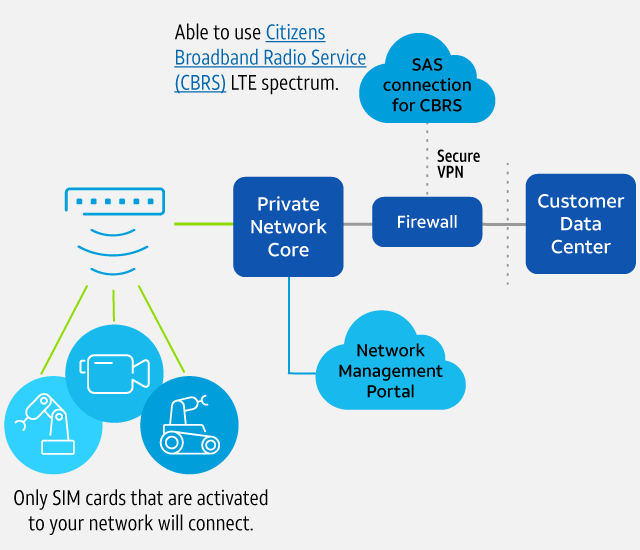
- Radio Design Flexibility. On-site small cells with seamless handoffs are dedicated to your network with flexibility to configure bandwidth, power settings, and radio locations.
- Network Privacy. Only SIM cards that are activated to your network will connect, helping to ensure you have control over how and which users connect.
- Network Visibility. Network Management Portal puts you in control of traffic on network segments, device management, and easy-to-access network Key Performance Indicators.

Pricing
Pricing that fits your needs
Customizable solution
Our sales managers can help right size your customizable solution to include: Core Hardware & Software, Radio Access Network Hardware & Software, Private SIMs, and Subscription for Services.
Features and details
AT&T Private Cellular Networks
FAQ
AT&T Private Cellular Networks
Private network solutions have begun to emerge enabled by a new shared spectrum called Citizens Broadband Radio Service, or CBRS. Dubbed the “Innovation Band”, CBRS has been opened to anyone including enterprises by the Federal Communications Commission on a shared usage model. The hierarchical three-tiered model is governed by the SAS, or Spectrum Access System, whose job it is to allocate users to the available channels based on load and tier status. While anyone can use CBRS spectrum via the General Authorized Access Tier, Tier 2 Priority Access License holders receive higher priority upon contention, while Tier 1 incumbents, such as the US Navy maintain highest priority when needed.
And, as we look to the future, we expect enterprises will be able to enhance their CBRS-enabled private networks with licensed spectrum and network capabilities.